Views: 0 Author: Site Editor Publish Time: 2026-09-03 Origin: Site
For OEM procurement managers, scaling production hinges on securing reliable transmission components. You must source these crucial parts without inflating your overall bill of materials. Achieving this delicate balance ultimately drives your company's long-term profitability. Mastering this procurement strategy elevates your equipment's market reputation.
Sourcing these components in volume often presents a difficult conflict. You frequently face a stark choice between low upfront unit pricing and long-term mechanical reliability. Selecting the absolute cheapest option almost always introduces downstream assembly issues. It also triggers unexpected field failures which disrupt client operations.
This guide provides a practical framework for evaluating and shortlisting gearbox suppliers. We will show you how to ensure component consistency during mass production runs. You will learn proven strategies to mitigate persistent supply chain risks effectively. Our approach helps you identify real cost-efficiency extending far beyond the initial quote.
True cost-efficiency in bulk orders requires calculating integration time, failure rates, and maintenance overhead.
Selecting between WP and RV reducer architectures depends heavily on the spatial constraints and load profiles of your specific OEM equipment.
Evaluating a supplier’s batch-testing protocols and tooling consistency is more critical than negotiating marginal drops in unit price.
Phased rollout strategies—from single-unit prototyping to low-volume pilot runs—are essential to mitigate integration risks before committing to full-scale bulk orders.
Many buyers fall into a dangerous price trap early. Choosing the absolute lowest bidder often causes severe downstream operational issues. You might face inconsistent housing castings or rapid gear wear. Excessive thermal output remains another common component defect. These systemic failures inflate your overall lifecycle expenses dramatically. Finding a cost-effective worm reducer requires looking past the initial invoice. You must accurately evaluate the long-term impact on your production line.
Let us examine the core operational expense factors carefully. These elements dictate your actual profit margins eventually:
Assembly Line Friction: Dimensional inaccuracies slow down OEM assembly significantly. Your workers spend extra time modifying incorrect mounts. They struggle aligning off-spec input shafts constantly. This wasted labor costs far more than component savings. It also bottlenecks your entire production floor capacity.
Warranty Claims: Premature field failures severely damage your brand reputation. Sending technicians to replace units costs exponentially more. The replacement part itself represents only a fraction. You also suffer immense customer trust erosion over time.
Lifespan vs. Duty Cycle: You must match the gearbox rating exactly. Compare it carefully to your specific machine requirements. Under-speccing components leads to rapid breakdown under heavy load. Conversely, costly over-speccing wastes your valuable procurement budget. Finding the exact mechanical sweet spot is crucial.
A truly efficient component balances optimized material selection properly. It demands predictable and repeatable manufacturing tolerances across all batches. Focusing solely on unit cost ignores these critical financial realities entirely.
Choosing the correct architectural design dictates your machine's overall performance. You cannot standardize one single housing type universally across different machines.
Traditional heavy-duty applications demand exceptional durability above all else. Space is rarely the primary limiting constraint here. A cost-effective wp worm reducer serves these demanding scenarios perfectly. It features a highly robust cast-iron housing structure. This solid metal construction provides excellent vibration dampening during intense operation. Cast iron naturally dampens harmonic vibrations highly effectively. This prevents resonance issues in large industrial frames. It handles accidental physical impacts better than aluminum. It also offers superior thermal dissipation capabilities naturally. The lower raw material price makes bulk procurement highly attractive. Buyers prioritize structural rigidity and impact resistance over weight savings here.
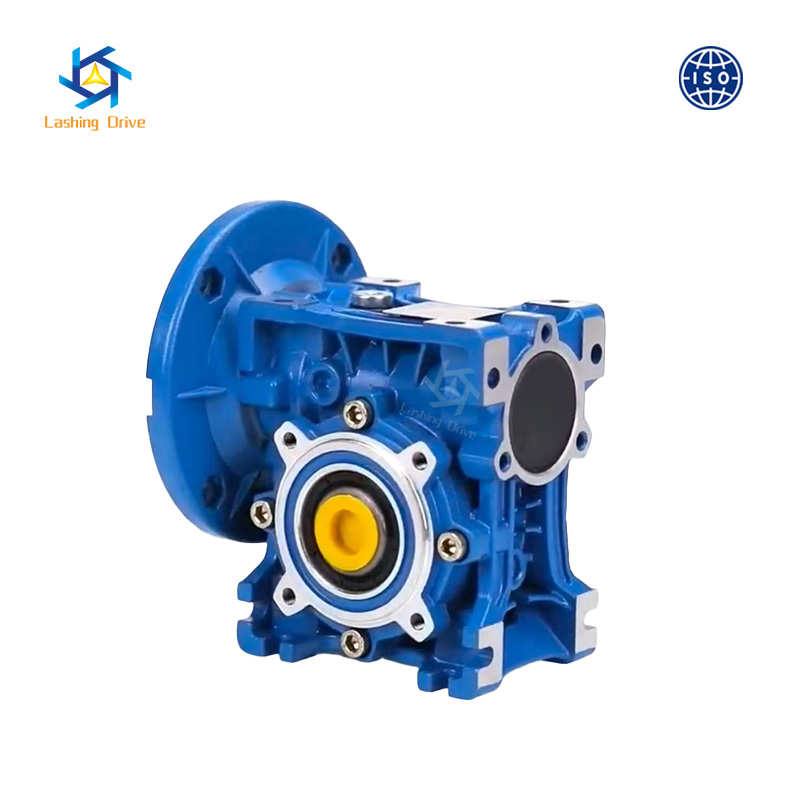
Modern automated machinery requires highly agile drive solutions. A compact rv worm reducer uses an advanced aluminum alloy housing. This deliberate choice provides significant overall weight reduction. It also naturally resists environmental corrosion without heavy protective coatings. Aluminum housings require advanced die-casting techniques. Suppliers must control porosity tightly during manufacture. Excellent thermal conductivity helps dissipate internal gear heat rapidly. The modular design features highly versatile universal mounting options. You can seamlessly integrate these units into very tight spatial footprints. Automation equipment and smart conveyor systems rely heavily on this agility. Packaging machinery designers also prefer its sleek mechanical aesthetics.
Table 1: Key Differences Between WP and RV Architectures
Feature Matrix | WP Series Architecture | RV Series Architecture |
|---|---|---|
Housing Material | Heavy-Duty Cast Iron | Lightweight Aluminum Alloy |
Weight Profile | Heavy (limits portability) | Lightweight (optimizes agility) |
Vibration Dampening | Excellent (absorbs harmonics) | Moderate (requires stable mounts) |
Corrosion Resistance | Requires industrial painting | Naturally oxidation resistant |
Mounting Flexibility | Fixed base orientations | Universal/Omnidirectional setup |
Ideal OEM Applications | Crushers, heavy lifting hoists | Robotics, packaging lines |
Industrial machines routinely encounter widely varying operational stresses daily. You must evaluate anticipated load types carefully before ordering bulk batches. Engineers strongly differentiate between steady loads and moderate shocks. Heavy shocks require entirely different gear hardness specifications. Applying a standard duty unit to a heavy shock application guarantees failure.
Consider a highly practical industrial application example. You need an oem worm gearbox for small mixer equipment.
The Challenge: Industrial mixers demand incredibly high starting torque. They endure continuous radial loads on the output shaft daily. The internal gear teeth constantly battle variable viscosity resistance. As the mixture thickens, torque requirements spike unpredictably. Shock loads multiply the nominal torque requirements exponentially. A mixer hitting a solid pocket of material experiences this instantly. The gearbox takes the entire mechanical brunt directly.
The Solution: You must specify drive components very carefully. Demand precision-ground worm shafts for smoother power transmission. Insist on optimized bronze alloy gear wheels always. High-grade synthetic lubrication remains absolutely mandatory. Bronze alloys provide a sacrificial wear surface safely. Precision grinding increases the contact area between mating gears. This lowers the localized surface pressure significantly. These elements prevent premature gear wear during high-strain conditions.
Components must meet rigorous industry safety standards. Food-grade mixing environments require specific IP ratings universally. These ratings ensure internal protection during aggressive chemical washdowns. Ignoring compliance invites regulatory fines and dangerous safety recalls.
Securing the right manufacturing partner minimizes your production risks entirely. You must evaluate their internal processes rigorously before signing contracts. You need suppliers committed to continuous improvement. Review their internal non-conformance reports transparently.
Follow this structured evaluation framework during bulk procurement:
Batch Consistency & Quality Control (QC): Question how suppliers guarantee exact dimensional consistency. Can they maintain peak performance across a 500-unit order? Demand absolute transparency regarding their internal testing procedures. Require Coordinate Measuring Machine (CMM) inspection reports. Ask for documented gear backlash testing results. Insist on thorough noise and vibration signature analysis.
Supply Chain Resilience: Assess their raw material sourcing stability thoroughly. Investigate their true in-house machining capabilities deeply. Beware of suppliers displaying severe over-reliance on external sub-contractors. Sub-contracting creates a dangerous quality blind spot. You lose visibility over raw material origins easily. Direct manufacturers generally offer much tighter quality control loops. They also insulate you from sudden geopolitical material shortages.
Customization Capabilities: OEM builders often need highly specific component modifications. Evaluate their ability to accommodate custom private labeling. Can they provide unique custom shaft dimensions quickly? Ask about engineering specific mounting flanges. Avoid suppliers charging exorbitant Non-Recurring Engineering (NRE) upfront fees. NRE fees cover specialized tooling or custom molds. Flexible suppliers amortize these costs across your bulk order. This keeps your per-unit price highly competitive.
Smart buyers never rush blindly into volume manufacturing. A phased rollout approach protects your capital investment safely.
You should never move straight to bulk ordering. Always require a formal First Article Inspection (FAI) document. Conduct rigorous lifecycle testing on one to five sample units. Run them continuously inside your own facility. Testing must simulate worst-case operational scenarios accurately. Run the gearbox at maximum rated torque continuously. Measure the exterior housing temperature hourly. Inspect the oil for bronze shavings afterward. This confirms real-world performance metrics match paper specifications. It reveals hidden design flaws before mass production begins.
Clarify factory-fill lubricant standards extremely early. Using substandard mineral oil in bulk orders causes systemic overheating. Ensure your supplier uses appropriate high-grade synthetic compounds. Factory lubricants sometimes use cheap mineral bases originally. These break down rapidly above specific temperature thresholds. Synthetic oils maintain their viscosity curve much better. These advanced lubricants must suit the specific operational environment. High ambient temperature environments demand specialized thermal viscosity ratings.
Establish incredibly clear Service Level Agreements (SLAs) promptly. Define strict delivery lead times before signing any contracts. Outline defective unit replacement protocols via RMA channels. Negotiate buffer stock agreements proactively with your account manager. SLAs force suppliers to maintain critical safety stock. This buffer absorbs sudden demand spikes easily. This strategy prevents catastrophic OEM assembly line downtime. It shifts inventory carrying costs partially back to the supplier.
Sourcing bulk transmission components remains a highly strategic decision. It directly impacts the fundamental reliability of your OEM product. You must control every aspect of the procurement journey carefully.
Shift your primary procurement focus entirely away from the cheapest unit.
Partner directly with a transparent, highly responsive component manufacturer.
Demand comprehensive QC testing data and consistent batch execution constantly.
Draft a detailed technical specification sheet outlining specific machine duty cycles.
Clearly define all spatial limits before initiating Requests for Quotation (RFQs).
Executing these precise steps guarantees better supply chain stability. It fundamentally elevates the quality of your finished machinery. Start by auditing your current supplier against this strict framework today.
A: MOQs vary heavily by manufacturer. Custom shaft or flange modifications typically require 50 to 100 units. Standard configurations may be available in much lower bulk tiers. Always negotiate pilot run volumes before committing to large customized batches.
A: Request comprehensive First Article Inspection (FAI) reports. Ask for material composition certificates, especially for the bronze worm wheel. Order a sample unit first. Conduct destructive and lifecycle testing inside your own facility to ensure reliability.
A: Rarely, and never without extensive engineering modifications. They may offer similar ratio outputs initially. However, their mounting footprints differ significantly. Shaft center distances and thermal properties also vary. Base your choice on specific spatial and environmental needs.